Showing posts with label animal solutions. Show all posts

Tuesday, January 28, 2014

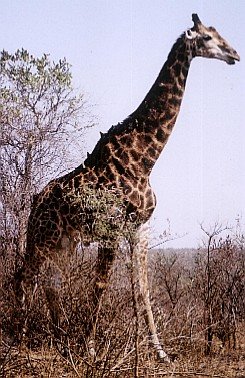
How the threat to lions, leopards and wolves endangers us all

ORIGINAL POST FROM THE GUARDIAN ( http://www.theguardian.com/environment)


Cape Times 6-12-1012


How the threat to lions, leopards and wolves endangers us all

Though fearsome killers, big carnivores are also a precious resource, as their feeding habits keep many delicate ecosystems in balance. But too many predators are now facing extinction
They are the planet's most prolific killers – and also some of nature's most effective protectors. This is the stark conclusion of an international report that argues that lions, wolves, pumas, lynxes and other major carnivores play key roles in keeping ecosystems in balance. It also warns that the current depletion of numbers of major predators threatens to cause serious ecological problems across the globe.

The paper, written by a group of 14 leading ecologists and biologists from the US, Europe and Australia and published in the journal Science, calls for the establishment of an international initiative to conserve large carnivores and help them to coexist with humans. Failure to protect our top predators could soon have devastating consequences, they warn.

"Globally, we are losing our large carnivores," said William Ripple, the report's lead author. "Many of them are endangered and their ranges are collapsing. Many are at risk of extinction, either locally or globally. And, ironically, they are vanishing just as we are learning to appreciate their important ecological effects."

The report has been produced, in part, to show that the classic vision of a large predator, such as a lion or a wolf, being an agent of harm to wildlife and a cause of widespread depletion of animal stocks is misguided. Careful analysis of predators' food chains reveals a very different picture. "In fact, the myriad social and economic effects [of large carnivores] include many benefits," it states.
http://www.theguardian.com/environment/2014/jan/26/endangered-species-carnivores-extinction

Cape Times 6-12-1012

Sunday, December 4, 2011

Tiny Tim's second day incaptivity

(preview of the full story still being edited)

4-12-2011
Before I go further, I need to confess that I am not sure if the chick is a Tim or a Timothy.

Tiny Tim had a bit of a stressful day today.

At first I overslept and the birds were already chirping outside when I realized that the chick is still inside; so I put him out very quickly. He was again fast asleep and I did not know if he was dead or alive. My concern was that Mary would notice that the cage was missing and abandon her chick.

I did not have to wait long for her to arrive with breakfast.

It was a very hot and windless today. The heat was just hanging in the air with no wind to fan it.
The poor chick’s, mostly plastic, mouse cage must have been sweltering hot. The deep plastic bakkie (bowl), which I rigged out to be his temporary nest, must have made everything ten times worst.

At one stage I thought he was going to die from heat. He was sitting on the side of the nest with his mouth open and his head hanging, panting.
I went for the syringe and squirted a bit of water down his neck, which stressed him to the extent that he did not make the right chick sounds when Mary approached with food so she left, thinking he was full.

I exchanged the plastic bakkie with a little utility basket about cup size but when he sat on the side of it, it collapsed. Mary was hesitant to get near the cage, so I removed the basket and put a shallow cat food bowl in the cage at which time Mary attacked my head but, although she attempted to enter the cage about 20 times afterward, she seemed to be scared to get near it.

After much observation, I realized that the cat food bowl is blue and perhaps it is a color she did not like, so I had to disturb the poor chick once again to remove all bowls and replaced it with a simple fluffy white carpet made from some woolly cloth.
The chick managed to jump out of my hand, during the re-furnishing of his cage, and landed on the cement floor then scurried under the fridge.

By the time I managed to get him out from under the fridge it was already 5pm.

I stuck him back in the cage and decided that I was his worst enemy and if Mary still does not feed him it will be back to pro-nutro tonight.

Mary tried to entice Tiny Tim to leave that unsafe place by flying towards the cage then out to the bushes at first. He tried to follow his mother, but he is still too weak to get to the top of the cage.
To our delight Mary decided to recommence feeding again, she seemed to be content with the new nest arrangement.

I covered the cage with a towel and put it in a quiet room for the night. I hope that I do not oversleep, like this morning, again.

Monday, August 22, 2011

How to fight the rhino horn poaching problem as well as other wildlife transgressions?


African problems need African solutions.
Rhino horn is destined for China and other countries that believe in magic potions.
People who believe in magic potions also believe in curses and protective forces.

A problem-solving meeting between top African Sangomas, global energy healers and ancestral advisers (People who can hear the voice of the ancestors) can be staged here in Cape Town. They can solve this problem using African magic. This meeting can be paid for with lotto funds.

A curse can be placed on those who use or remove rhino horn for self gain. A protective ring can be cast around our game reserves. If rhino and other African animal horns are cursed, it will loose its magic power.

However, the meeting should not only concern the curse of the horn but also discuss how traditional healers and sangomas can obtain their needed supplies for the use of their magic poaches without destroying our natural resources.

Nature parks can for instance allow natural healers access to plants as long as they help to maintain the local species and help to identify and regenerate problem areas. Alternatively living Sangoma pharmacies can be grown.

Even the sangomas who use human body parts can brainstorm ideas of how to obtain their specimens legally without causing pain or hardship to innocent victims.

Instead of using the sexual organs of virgins or babies to cure aids for instance they may agree to use cord blood or the blood of a placenta instead of killing a baby.
This does not have to mean that we approve such superstitious methods, but Africa has to evolve her own belief structures.

Denying people the right to practice the black magic art may only make the mootie more valuable when the practice is pushed underground. Most users care little how the animal part has been obtained or if the animal, or human, was live when it was removed. We can wash black magic by finding humane substitutes and the result may be that the cruelty of the past may disappear altogether when black magic turns gray.

African and traditional Chinese medical practices share many of the same principles.

Once the curse (protection) has been cast it can be announced via the Internet, Facebook and Twitter and Wallah! The rhino will have an invisible protective net.

Most Christians will frown at this post, and the suggestion of aiding and abetting black magic. I do not blame us, but we need to remember that the majority of people living in Africa are traditional believers. The spirit of Africa needs to be washed by her majority.

The difference between white and black magic on all levels is that the black magician uses his magic to empower himself or individuals (or his lower nature).
The white magician uses his magic for the good of the whole (The nation or the group) or his soul nature, without expecting self-gain.

Pain and animal or human sacrifice is no longer the way of the evolved, more sensitive, human but Africa needs to grow at her own pace. She shall do it through her own believe structures and not by adopting foreign religious doctrines, even if in the end all humanity may be destined for one religion when they recognize the different faces of the ONE GOD.

PHOTO ALBUM


Finding solutions to the rhino poaching problem


Poachers killed another rhino, this time in the Western Cape.
While criminals and syndicates have a stronger firepower than the police force, there is little concern from the side of the poachers. They know the game rangers and police will do their job but at the same time they, the police and rangers, fear the power of the poachers. The intervention by police only increases the adrenaline rush in the poachers. This little possibility of being caught only increases the value of the horn and my even be welcomed. Even the courts treat poachers very lightly.


Some of the game rangers themselves are informants for the poachers. Who would not offer the life of an animal in exchange for a few thousand rand extra?

It is time we employ a strength that can out match that of the syndicates. How can this be done?

1. Declare war against the poachers and employ the army in conjunction with the police force.
2. Implant satellite-tracking chips into the horns of a selected group of wild animals. Do not paint them and do not even notify the rangers which wildlife are being chipped. Chip some rhinos in all the camps. Let the horn lead the intelligence forces to the doorsteps of the syndicates. Do this throughout Africa. Some war torn African countries are trading horn for weapons.
3. Kill the demand. I shall blog about this in my next post. The solution is much simpler than we realize. Watch this space.

Visit PHOTO ALBUM

read NEWSPAPER ARTICLE


Wednesday, April 6, 2011

BABOON EXTERMINATION AROUND TABLE MOUNTAIN


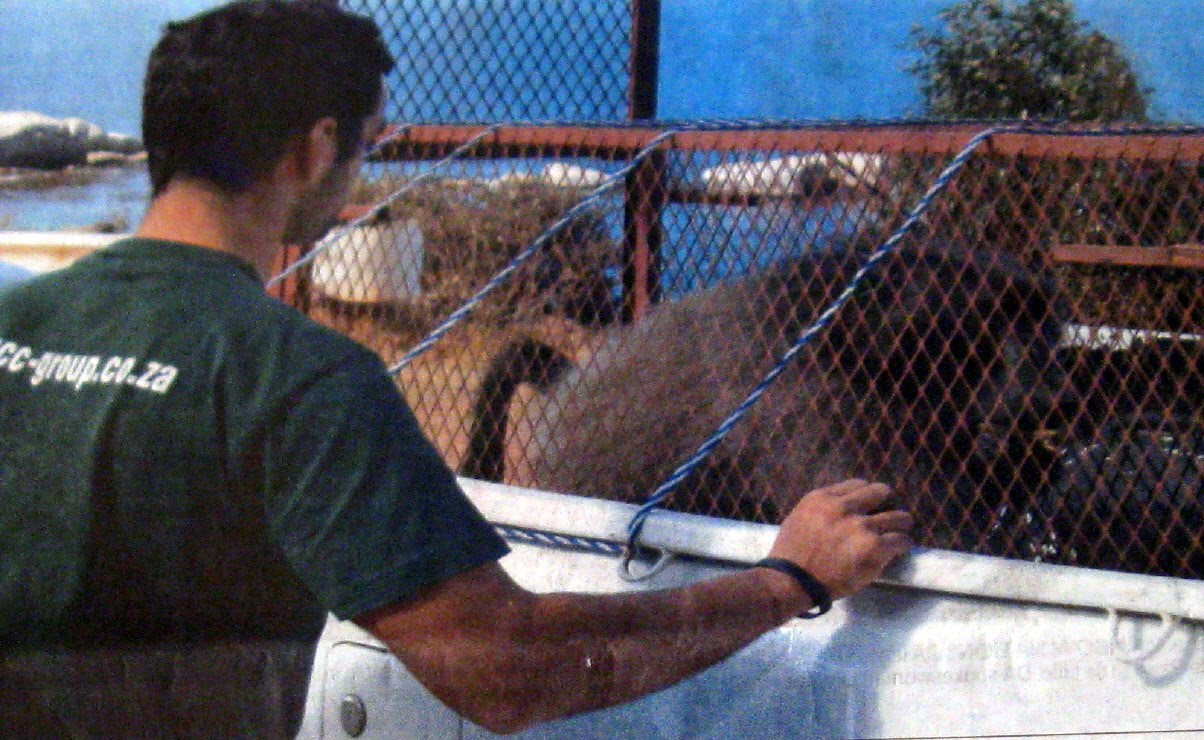
FIRST THEY KILLED BART AND NOW FRED

Another baboon died by the wisdom of the baboon caretaker squad in Cape Town, last week.
Even though this is happening during an election year and in a DA ruled province, Helen Zille is still the only politician who spoke out about the lack of attention the animals in nature are receiving from our conservation efforts. We will sacrifice their shelter, habitat and food source, to further for our emotional, indiscriminate fynbos recovery efforts.

We all know that the fynbos is being threatened with extinction and needs preservation, but so are many of our animal and insect species who were forced to seek shelter and habitat in an alien environment.

So if you love animals and nature the DA still deserves your vote.
(I am not siding with any party in particular, except for the one that supports the quality of all life, the poor as well as the defenseless. I will also side with the political party that will put his money where his mouth is and not in his/her own pockets)

1 I was just wondering if the conservation training covers animal behavior and psychology. Are they taught how to tune into nature and mentally get into the thought or survival patterns of the habitats that are threatening the perfect vision of co-habitation of animals and plants? Can anyone tell me?
2 What type of student chooses conservation as a career? Is it those who love nature or is it students who do not have the courage to tackle difficult subjects? In the past animals were voiceless victims, but thankfully in today’s society there are many nature lovers who are speaking up for our silent victims and are starting to use the Internet to fight their cause. Soon we will have to train conservation students who are sensitive to the life forms they control.
3 Do the conservation students learn all about laws and botanical names at the beginning of their curriculum, and if they are taught to tune into nature by observing any species, is the training offered at the end of their term? Will some students pass their degree without having had time to build that much needed quality to make holistic decisions? How many first year students have silently sat in nature and ask themselves the question: “What does this particular area need”, and then listen to their intuition for answers?

The baboon squad should have had the sensitivity and knowledge to come up with better solutions than killing the alpha males, who adopted the survival behavior of low class humans. It is so sad that experts, who have been employed to solve the baboon problem, could come up with no other solution than to kill them.

Whenever baboons evolve and adapt they are exterminated or locked I cages in some zoo. By taking out the alpha male every time, they leave behind the weaker ones to lead the troop (often into trouble). For animals to survive in this unfriendly environment, where people squeeze them out of their habitat, chop their shelter down, burn their food supply and take pot shots at them and commit acts of cruelty to deter them, we need the strong, intelligent ones to survive and guide the troop.


There have been lots of animal experiments done, internationally, on how to change the behavior of animals; they include, naming a few methods:
1 Shock treatment when animals behave unfavorable and reward them when they behave the right way.
2 The use of animal whisperers,
3 High frequency sound waves etc.
4 Booby traps in homes, bins and vehicles and other places of unsocial survival attempts by the baboons.
5 Pepper spraying of baboons that approaches vehicles and homes.
6 Supply food in a space that can also become a tourist attraction and provide the necessary funds to manage the existence of the species.
7 Set up trust funds or other initiatives to employ necessary international expert or humanitarian groups to train our conservationists.
(Sometimes we may need to be a bit cruel, in the beginning, to save the lives and existence of a troop of baboons.)

The nature of wild animals is to live in one area but move onto another more suitable habitat when the area becomes to overpopulated for the available food supply. Because the baboons can no longer split the troop and look for food somewhere else, they adapted by getting additional food by raiding the obstructive human habitat. This is a very clever adaptive behavior pattern.

We can prevent this by also being clever and provide alternative solutions.
With the right survival training, who knows, perhaps they will one day learn how to propagate and grow their own food in their protective habitats?


There is a lot we can experiment with and learn from the behavior of these animals and there is a lot they can learn from us if we use methods other than kill the clever ones.

They need our help and understanding not their execution and eventual extinction.


Rosalie - 6 April 2011

Saturday, February 26, 2011

Trees are a natural solution for over populated areas.


The best of both worlds.
Trees offer life for some animals and birds out of the reach of predators.

The Lord’s Prayer for animals forced into extinction by the efforts of man.

God forgive us for our narrow-mindedness and blindness due to the fact that we cannot see the bigger picture.
If our conservation efforts are your will, please bless our actions.
If not, forgive us for we do not always know what we are doing.
If the animals and birds suffer because we temporarily destroyed their chance of survival in order to give future animals a better place to live in, please provide a special habitat for them, with lots of food and trees where they can live undisturbed in animal heaven.

Amen


The latest tree felling at Table Mountain and at Rietvlei, Cape, prompted this prayer

Thursday, June 17, 2010

Penguin chicks die from cold

It is time we change the focus of conserving local species; to try and save the species of the world in places where they can survive.

We may need to move animals around and that is going to be very difficult.   We still know so little about ecosystems and even the function and interrelationships of the smaller life forms in the wild.


Article from Cape Times 17-06-010

Saturday, June 5, 2010

Global warming hits my Cape Town garden


It is official.  Global warming is here.   If there is any doubts, put it aside and do what the scientists of the day advise us to do to reduce greenhouse gasses; because we do not know how warm it will get before things change back to normal.

The shortest day is on 21 June.  I remember that date because it is my mother's birthday.     My mother has her birthday in the middle of the winter.

Today, 5 June, not yet mid winter, my birds are doing the spring thing.
They are breaking last year's nests down, building new ones and are in mating plume.


It is time conservationists put their old conservation thoughts on the subject into archives and start to work our how to preserve species during the global warming phase of the earth.


It is stupid to keep local species local if conditions are not suitable for the survival of the specie.

This is a challenge for humanity, but we have the intelligence to counteract these earth changes with drastic measures.

Nations must stop fighting against each other because now it is a time for co-operation; in the wake of the expected global natural catastrophes awaiting earth dwellers.

Tuesday, January 12, 2010

Frustrated dogs


We went to the beach this weekend and saw for the first time a lot of angry frustrated dogs on leads.

Dogs also need the freedom to play and run.   Some of them love the water.
They are like little children.   Keeping them tied up on such a large playing field is cruel and frustrating for them.   It can turn a friendly natured pet into one that is frustrated, angry and vicious.

If the only reason that animals should be kept on leads is for the safety of beach goers, then perhaps the municipal law should allow for animals run and play on the beach if they are wearing muzzles.

Draft dog by-law

Find link to previous dog law post

Sunday, November 29, 2009

How to give water to a tortoise


While some domestic tortoises learn to drink from a saucer, they enjoy a drink from a hose.
Aim the hose away from the tortoise, and not directly on the animal.

The water will run towards the tortoise and he will suck it up from the ground.
Make sure the tortoise does not get blinded by splashing mud.

In the wild, tortoises can supplement their fluid intake by eating succulents.
Baby tortoises need to have a drink soon after they hatch.

Saturday, September 5, 2009

The life of a goose in a busy city suburb


These photographs were taken by Wally. He had to try and stop the traffic in De Grendel rd. so that the geese could cross.
They can not fly yet and are at the mercy of dogs, people and other predators.
One year, at Rietvlei, we watched how they disappeared one by one over a period of about a week.

Saturday, June 13, 2009

Considertions before keeping a tortoise as a pet

Keeping a tortoise as a pet.

In South Africa a license is required to keep a tortoise on a domestic property.
As with any other pet, we need to determine whether it is fair to keep a tortoise.

We need to consider certain facts before adopting a tortoise as a pet.

  • Why did we choose to have a tortoise as a pet?
  • That a tortoise, given the right environment, can live a long time. (150 years)
  • That tortoises are not cage animals and require a large space.
  • They are territorial and keeping two males in a confined space are cruel. They will fight and sometimes to the death.
  • That tortoises require food in order to survive.
  • They require a space that is not damp yet provide sun and shady areas.
  • That they require a space free from floods.
  • They need a dry undisturbed area, of their own choosing, for hibernation.
  • They may drown if they fall into an open swimming pool.
  • Dogs will chew them.
  • They do not like being handled.
  • Conservationists are not keen to accept a domestic tortoise back into a conservation area once it has been in captivity.
  • Domestic tortoises, like any other introduced animal, requires a time in quarantine, in case it carries disease, before it is introduced into a conservation area. It will only be accepted if the local population requires a boost.

Friday, June 12, 2009

Conditions that threaten the survival of tortoises in the wild


Keeping a tortoise as a pet

In South Africa a license is required to keep a tortoise on a domestic property. Tortoises are classified as wildlife, and will fall under the same laws.
In my opinion considering the state and treatment of our natural open spaces and the changing weather patterns, the survival of the species my very well in the future depend on backyard tortoise breeders.


---------------------------


Although a tortoise is very hardy, they are very defenseless against unnatural conditions.

Situations that threaten tortoises in the wild:
  • Changing weather patterns.
  • Increasing incidences of field fires.
  • Roads bordering conservation areas.
  • Plans to develop open spaces in the future.
  • 4x4 vehicles and bikes
  • Floods

Maintenance of open spaces or conservation land like:
  • Lawn mowing
  • Artificial irrigation
  • The use of industrial lawnmowers.
  • Back burning and field fires.
  • maintenance vehicles
  • The use of insecticides, weed- and grass killers on conservation land.
  • The total ignorance or disinterest of some conservation workers and managers.
  • Absence or lack of wildlife awareness training of conservation workers and staff.

-----------------------------------------------------------------------------------------------

If a survey is done one may find that the training of conservation workers consists of nearly entirely on how to use machinery and implements for maintaining conservation land without considering the life of the creatures on it.

The conservation training of staff may often be the responsibility of reserve managers who may lack in their duties or knowledge and require supervision themselves.

Saturday, November 15, 2008

Sensitive workers are needed in conservation areas


Beach cleanup, along nature conservation areas, should be done under the supervision of our conservation department; and not by the parks department workers.
Contract workers are often employed to work in sensitive areas with no training regarding conservation. They are expected to be sensitive to the plants and animals, in conservation areas, and often left to their own devices.

Last year beach cleanup teams were operating while the Oystercatchers were rearing their chicks. The plovers and other beach dwellers were also not considered.
Luckily, these people were quite lazy and did little other than sunbathing.

The school children that were sent to collect rubbish along the beach during breeding season did more harm. They trampled over the sensitive area in groups.
Seaweed, that hosts a multitude of little animals that form part of the beach birds' diet, is being removed to tidy the beaches.

The preservation of indigenous animals are as important as plants. Their numbers are decreasing at an alarming rate.

We should consider that Plovers breed in the same area where the sea spews out the rubbish.
We should not wait until they hit the endangered list before we take action. Prevention is ever better than cure.

Sunday, June 17, 2007

We murder animals

The future of wild animals in Africa are under threat. There is a tendency to expect animals to earn their keep.

There is no less pain involved when an animal gets killed for food instead of by a bullet for sport.

While humans feel the distorted need to hunt animals for sport, then let it at least form part of a natural feeding and population control process of animals living freely in the wild.

Allow animals to live a natural life span of at least five years outside in their natural habitat

Stop cruel canned hunting and forced animal breeding practices; rather increase the price tourists have to pay to hunt wild animals.

Let punishment for poaching and unlawful killing of animals measure up to kidnapping and murder of humans.

Carcasses of killed animals that are not needed for human consumption should be returned for the feeding of wild animals to minimise the need for them to hunt for food.

Create an international green star rating for game reserves that operate with the holistic well being of animals in mind.


http://healafrica3.blogspot.com/
http://paazab.com/
http://unitate.blogspot.com/
http://myweb.absamail.co.za/gardenbird/index.htm
http://animaladvocates.blogspot.com/
http://www.theanimalspirit.com/feralcatnetwork.html
http://halrescue.blogspot.com/
http://www.animalhubbub.com/